
Enough about me - what do you think about me?
Dead white poets and Afrofuturism in the English Curriculum
The cliche is that the victors get to write the history. They also get to write the poetry. I love British and American (often wrongly called English) poetry written in English - and I love the 'canon'. I collect first editions of poetry stretching back over four hundred years, and know much of it off by heart. It gives me an emotional vocabulary for life, and I return to words and phrases when I want to understand moments I am struggling with or celebrating. But... there is a 'but'.
As Virginia Woolf pointed out more than 100 years ago, if Shakespeare had a sister called Judith just as talented as he was, she wouldn't have ended up a writer. The opportunities, safety, expectations, modelling and financial resources would have been denied her; those things that the simple act of being a male, gave to Shakespeare. Don't get me wrong - opportunity does not make you a writer: talent and hard work do; but talent and hard work without opportunity lead nowhere.
So that is why males, who on population averages tend to score lower on emotional intelligence and aptitude for language than women, still massively dominate historical poetry to the virtual exclusion of women in some periods. The same exclusion affects people of African heritage in the UK historically.
The literature curriculums in the UK tried to address this by picking up a number of what is patronising called 'poems from other cultures' (and often these 'cultures' are actually UK citizens, so the phrase itself smacks of racism). These follow a predictable pattern: the poem is by an author of dual, or plural heritage, and the poem talks about how hard it is to integrate into UK mainstream culture, with the heritage culture being remembered as exotic and vibrant - which itself is another racist trope according to Edward Said's famous and important book Orientalism. It is almost a case of dominant culture saying 'enough about me, what do you think of me?'.
This term in the poetry unit for grade 8 we will be exploring the way poetry and power work. We will study some classics ( Yeats, Whitman etc. which are mind-blowingly good), but we will also then look at the way these very privileged voices give way to other voices.
I am excited to be looking at the poem and song Black by Dave, (with the consent of parents for the language use) and then moving on to poetry that not only deals with some of the challenges those with African heritage can experience growing up in the African diaspora, but also towards celebratory works of Afrofuturism. The release of Black Panther was a watershed moment for Afrofuturism, and a chance to celebrate the incredible continent all of humanity came from. Likewise the work of Jean Michel Basquiat has recently taken off, with one of his paintings recently selling for one of the highest figures ever paid for a modern painting (110 million dollars). I look forward to exploring some of the poetry of Afrofuturism too with our grade 8s.
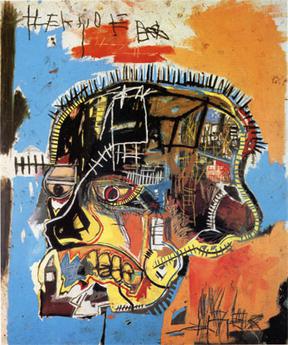 |
| Untitled Skull 1981 |
For many, any interruption to the literary Canon is taken as a threat to identity. It is almost like everyone with a seat at the table already is desperate not to get up and mingle with those without a seat, in case they find they don't have one when they try to sit back down again. But here's the thing about the literary table - it is infinitely large and infinitely varied. We never run out of seats, and everybody that comes to the dinner party brings a unique dish, a unique story and a new opportunity for friendship.
Comments
Post a Comment